KELOIDS & HYPERTROPHIC SCARS
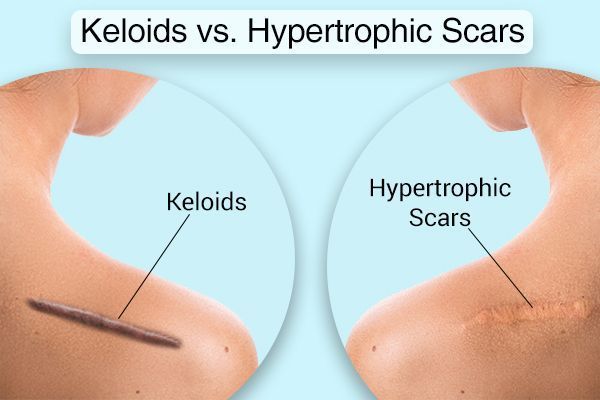
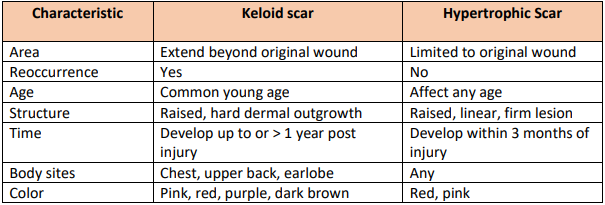
Naturally, scars happen as a result of skin healing after being damaged by cut, infections, surgery or injuries. The skin will repair itself by growing new tissues (new collagen fibers) to fill in the gaps in the wound and to mend the damage. During the final stage of wound healing, body automatically stops the collagen production. Once the wound is completely healed, then scar appears. Most scars are flat and pale in color because of the absence of collagen. But in some cases, body produces too much collagens causing the scars to rise and become more visible. These scars are called hypertrophic scars and keloids. Both of these scars commonly appeared on the skin surface, and look very much alike, thus leading to confusion among layman. The table below shows some easy ways to identify and differentiate them:
These are the main CAUSES of keloids and hypertrophic scars:
- Cutaneous injury
- Irritation
- Skin trauma
- Insect bite
- Burn
- Surgery
- Vaccination
- Skin piercing
- Acne
- Folliculitis
- Chicken pox
- Herpes zoster infection
Since both of these scars developed due to almost similar root causes, the treatments for both are quite mirroring as well. But patients must be well-informed that it is almost impossible to get rid of these scars entirely from the skin surface. The definite and ultimate goals for doing the right treatment is to flatten, soften, reduce the size, lighten the color and vanish any existing pain or itch caused by the scars. Therefore, the most suitable TREATMENTS for keloids and hypertrophic scars are:
A. Laser therapy
- It can lighten the pink or red color
- It also reduces pain, itch and hardness
B. Corticosteroid injections
- Injections are made into the scar tissue for several times to flatten and soften scar tissue.
C. Bleomycin or fluorouracil injection
- Either of these injections is made into the scar tissue to flatten the scar and reduce pain.
D. Cryotherapy
- Using extreme cold (liquid nitrogen) to freeze and destroy scar tissue.
- It helps flatten the raised scars.
E. Surgery
- The last option after all other possible treatments have failed.
For the conclusion, depending on the growth location, size and severity, keloids or hypertrophic scars could be painful, physically and emotionally. Some patients often mentioned it as disturbing and obnoxious thus potentially reduce the patient’s self-esteem and confidence. Thankfully, these kinds of scars can be treated with eithersingle or combined treatments. But for safety and long-term consequence reason, the treatments must be provided by the right expert such as dermatologist or medical doctor or certified aesthetician. Inaccurate or wrong diagnosis leads to incorrect medication or treatment, yielding in bad scarhealing management and worse side effects, for example, skin irritations, burnt skin, PIH, redness, swelling, etc.